Execution does not fail randomly. It fails when the system cannot hold under pressure. DEA examines execution as a designed system across five connected pillars — revealing both individual weaknesses and the interactions between them.

Diagnosis finds the node — not every symptom deserves equal attention
Most organizations have capable people and reasonable strategies, yet results drift due to structural breakdown. Execution only works when it is designed as a system of enforced choices, aligned structure, and visible performance.
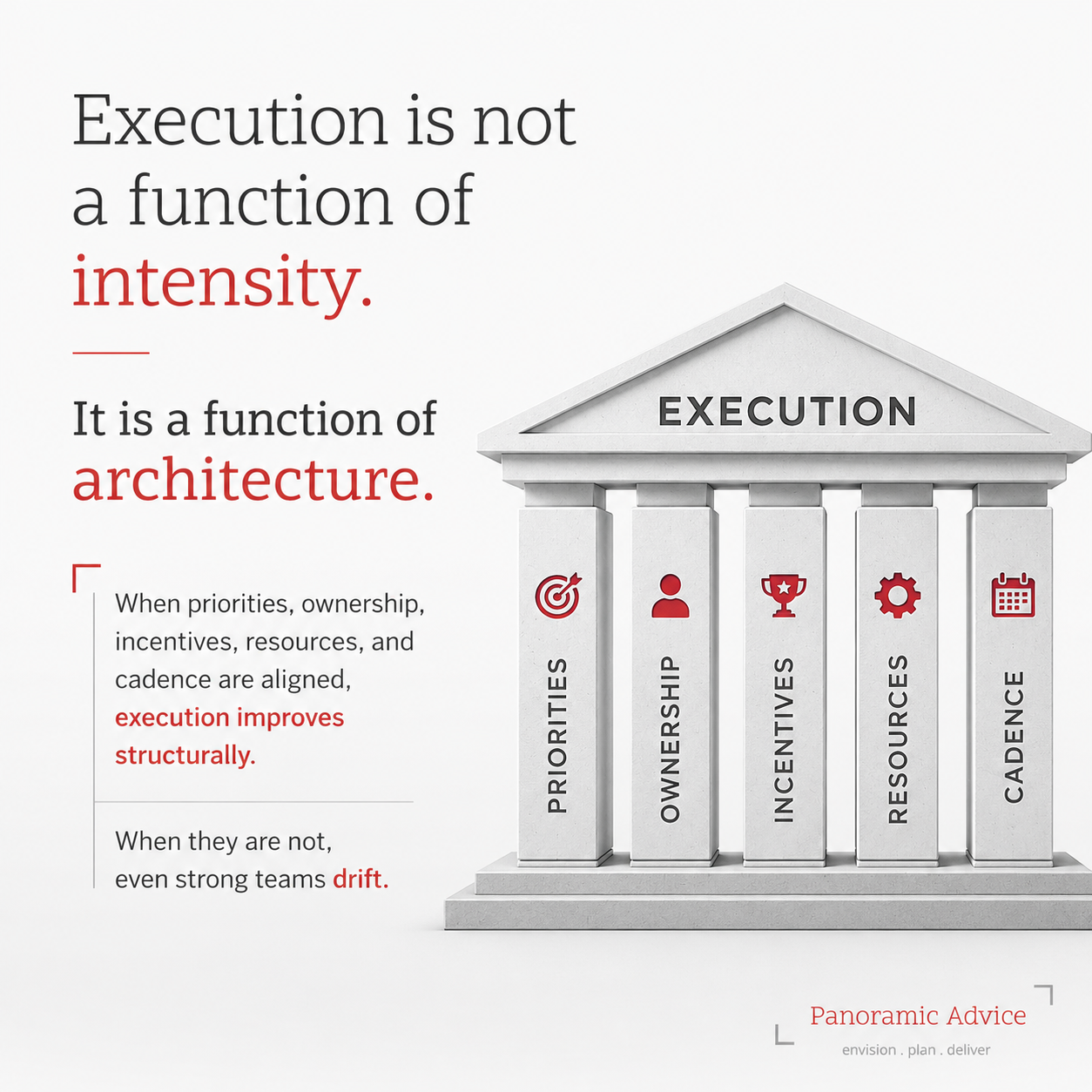
From the field — the same system, in operating-level terms
Few priorities exist and are consistently reinforced. Resources clearly follow those priorities.
Priorities accumulate without removal. Execution slows as resources are diluted.
Capital and attention drift toward whatever is loudest, not what matters most — until every initiative is competing with every other initiative instead of the market.
Each initiative is tied to measurable value, with clear ownership and accountability.
Work continues without impact. Ownership is unclear.
Investment keeps flowing into work that was never going to move the number — and by the time it's visible, the budget and the year are already spent.
Decision rights are clear. Resources are aligned to priorities.
Silos and bottlenecks block execution. Resources remain in legacy areas.
Good strategy dies inside a structure that can't deliver it — and every reorganization that skips decision rights just relocates the bottleneck.
Regular execution reviews. Leading indicators are tracked.
Lagging metrics dominate. Issues are detected too late.
Problems surface on the same day they become unrecoverable — leadership finds out from the quarterly number, not from the team.
Issues are surfaced early. Accountability is clear.
Problems are hidden. Reporting becomes unreliable.
Bad news arrives late and diluted — by the time leadership hears the real version, most of the response options have already closed.
Two Vocabularies, One SystemPanoramic Advice's LinkedIn content often describes this system in five plainer, operating-level terms. They aren't a second framework — they're how the five pillars above show up day to day.
Accountability isn't a single line item here — it's the thread running through all five, made explicit in the fifth pillar, Culture of Accountability & Transparency.
"No organization needs to redesign every part of its execution system at once. The purpose of diagnosis is to identify the few structural constraints creating disproportionate drag — then sequence the response."
The DEA Executive Diagnostic applies this framework to a specific organization — producing a maturity profile, the most material structural gaps, and a recommended intervention sequence.
Work With Us