Most organizations have capable people and reasonable strategies. Results still drift. Panoramic Advice diagnoses the structural conditions behind execution failure — and sequences the intervention that restores it.
Execution only works when it is designed as a system of enforced choices, aligned structure, and visible performance. When that system is missing, organizations respond with more meetings, more reporting, more pressure — activity increases while clarity does not.
Disciplined Execution Architecture (DEA) treats execution as an engineered system with five connected pillars, not a collection of isolated symptoms. The diagnostic question is never simply "where are we weak?" It is: which structural gaps are interacting to create the largest drag on value delivery — and in what order should they be addressed?

Execution rarely fails in one isolated place. Priority overload affects resources. Weak initiative logic complicates accountability. Unclear decision rights slow cadence. Poor transparency delays intervention. DEA examines these conditions as one connected system.
Strategy only exists where trade-offs are enforced.
If work is not tied to value, execution becomes activity.
Execution fails when the organization isn't built to deliver the strategy.
Without cadence, execution decays.
Execution fails when reality is hidden.
Two Vocabularies, One SystemPanoramic Advice's LinkedIn content often describes this system in five plainer, operating-level terms. They aren't a second framework — they're how the five pillars show up day to day.
Accountability isn't a single line item here — it's the thread running through all five, made explicit in the fifth pillar, Culture of Accountability & Transparency.
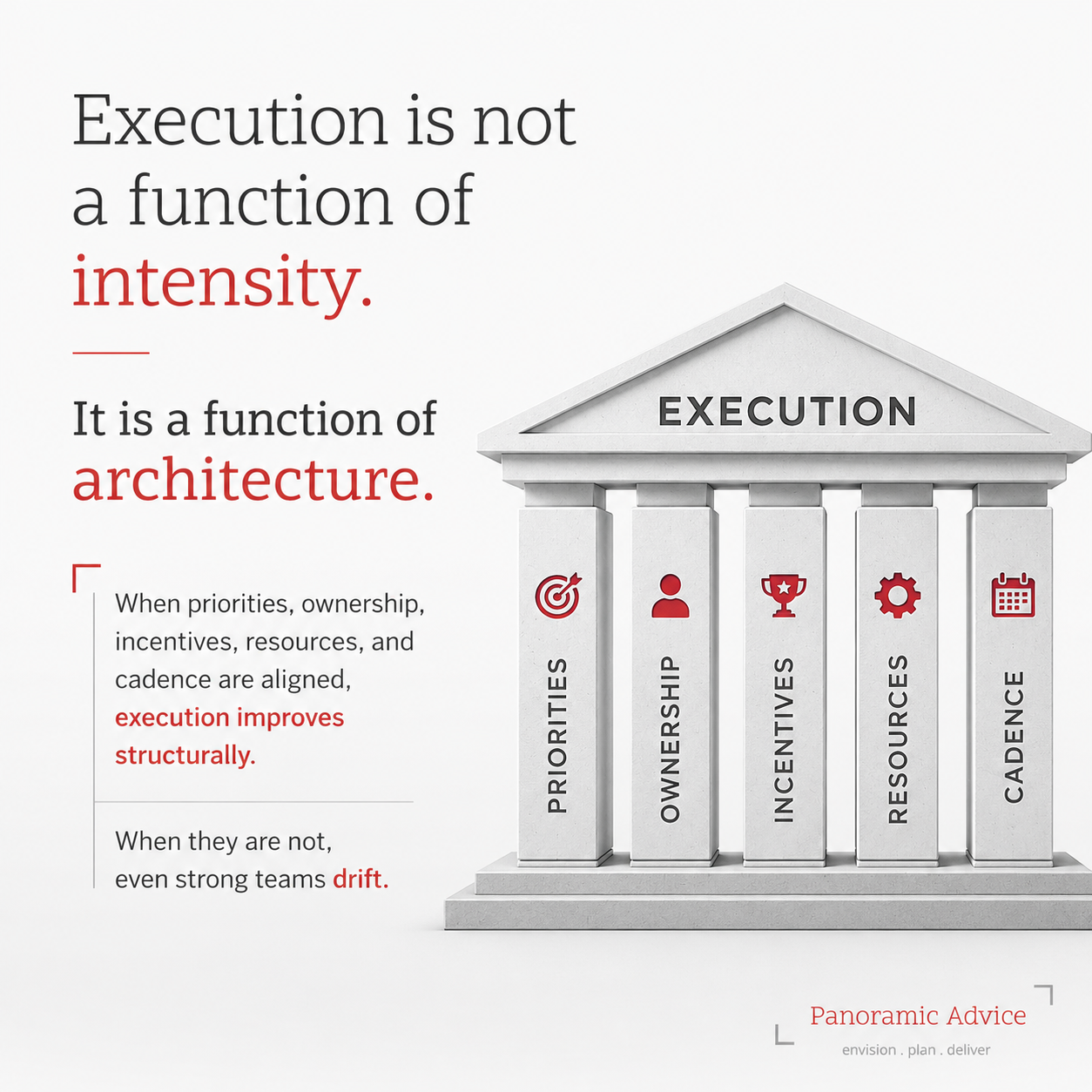
From the field — the same system, in operating-level terms
"Execution is not a function of intensity. It is a function of architecture."
A tiered path from diagnosis to sustained advisory — sized to how much structural change the organization is ready to take on.
A structured review across the five pillars, producing a maturity profile, the three most material structural gaps, and a recommended intervention sequence.
Focused, sequenced work on the highest-leverage structural gaps identified in diagnosis — with defined cadence and milestones.
Ongoing structural counsel to CEOs, boards, and PE operating partners, scoped around the engagement rather than a fixed package.
Cadence is not a calendar of meetings. It is the mechanism that repeatedly compares strategic intent with operating reality.
An initiative can hit every milestone and still fail to create the value that justified the investment.
Transformation is not a project. It is the outcome of disciplined execution sustained until it produces measurable value.